 Timon Scholz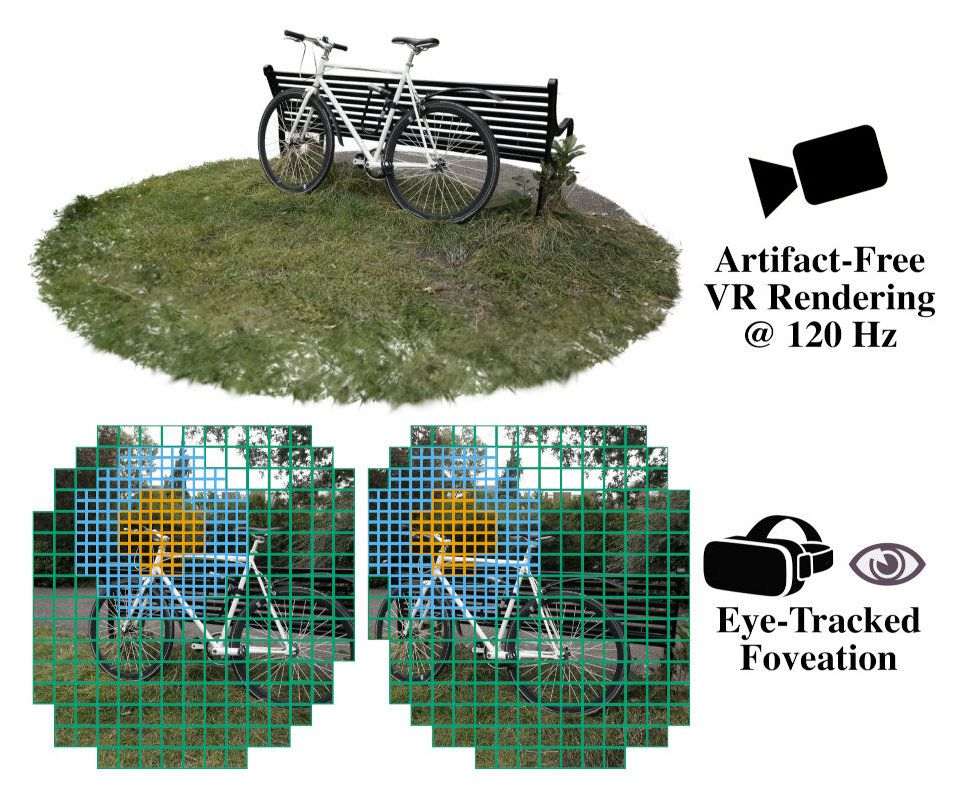
Fast Eye-Tracked 3D Gaussian Rendering for Virtual Reality
Oral Presentation Gaussian SplattingVirtual realityFoveated renderingEye trackingImage-based renderingRasterization
Proc. Vision, Modeling and Visualization (VMV), 2026
Computer Graphics Lab,
TU Braunschweig Timon Scholz, Computer Graphics Lab,
TU Braunschweig Florian Hahlbohm, Computer Graphics Lab,
TU Braunschweig Martin Eisemann, Computer Graphics Lab,
TU Braunschweig
Cluster of Excellence PhoenixD,
Leibniz University Hannover Susana Castillo, Computer Graphics Lab,
TU Braunschweig
University of New Mexico,
USA Marcus Magnor
VR-HTGS enables artifact-free, eye-tracked foveated rendering of 3D Gaussian Splatting in VR at 120+ Hz by dynamically adapting the tile-based rasterizer to a heterogeneous tile layout following the gaze position, without sacrificing perceptual quality or model fidelity.
SPaGS: Fast and Accurate 3D Gaussian Splatting for Spherical Panoramas
Oral Presentation Image-based renderingGaussian SplattingReconstructionRasterizationPanoramic ImagingUAV
EGSR 2025 (CGF Journal Track), 2025
Computer Graphics Lab,
TU Braunschweig Junbo Li, Computer Graphics Lab,
TU Braunschweig Florian Hahlbohm, Computer Graphics Lab,
TU Braunschweig Timon Scholz, Computer Graphics Lab,
TU Braunschweig Martin Eisemann, Computer Graphics Lab,
TU Braunschweig Jan-Philipp Tauscher, Computer Graphics Lab,
TU Braunschweig
University of New Mexico,
USA Marcus Magnor
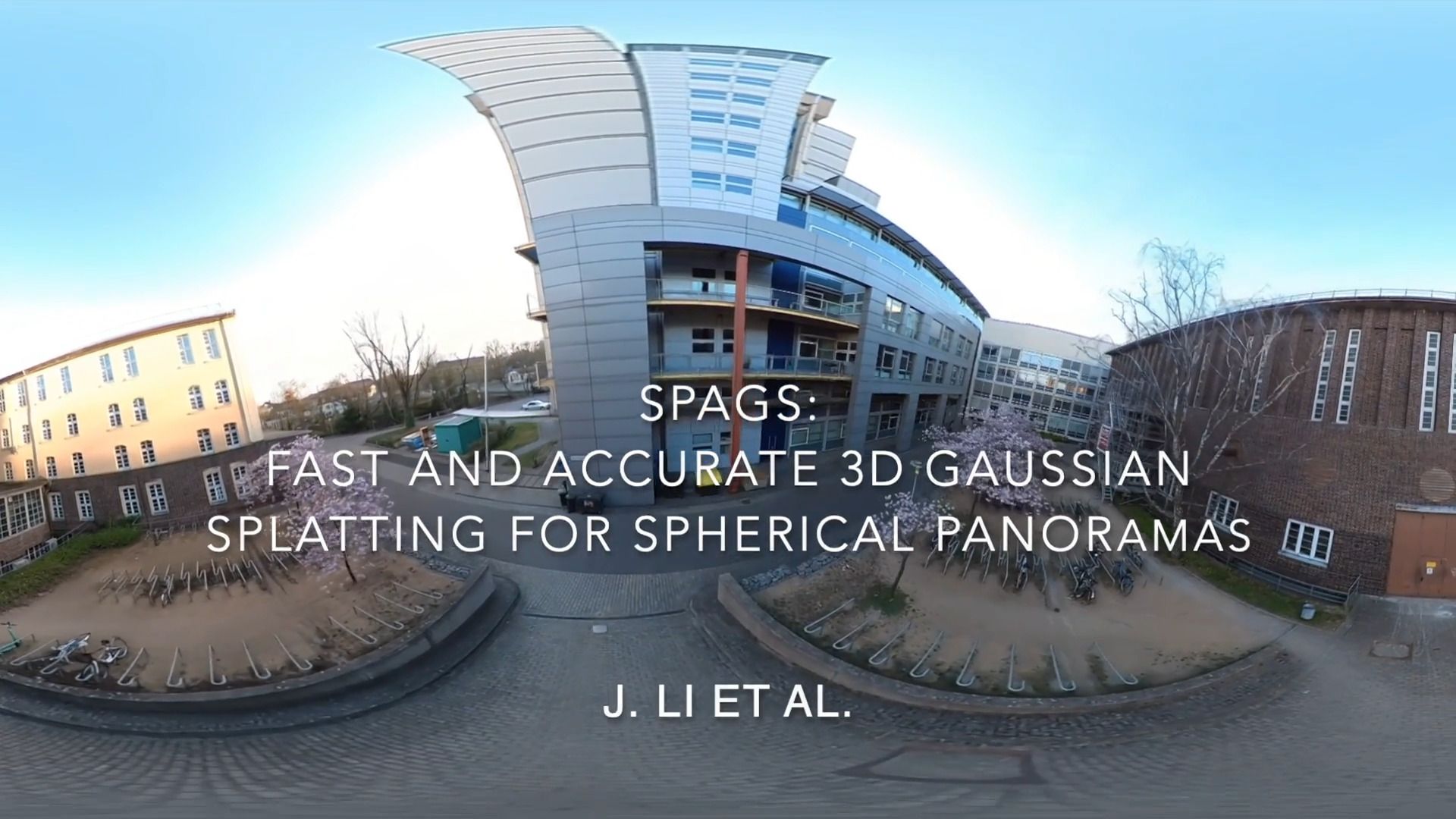
SPaGS enables high-quality, real-time free-viewpoint rendering from 360-degree panoramic images by introducing a new method for computing axis-aligned bounding boxes for spherical images that significantly accelerates omnidirectional ray casting of 3D Gaussians
D-NPC: Dynamic Neural Point Clouds for Non-Rigid View Synthesis from Monocular Video
Oral Presentation Image-based renderingPoint-based modelsReconstructionRasterization
Eurographics (Computer Graphics Forum), 2025
Computer Graphics Lab,
TU Braunschweig Moritz Kappel, Computer Graphics Lab,
TU Braunschweig Florian Hahlbohm, Computer Graphics Lab,
TU Braunschweig Timon Scholz, Computer Graphics Lab,
TU Braunschweig Susana Castillo, Max Planck Institute for Informatics,
Saarland Informatics Campus Christian Theobalt, Computer Graphics Lab,
TU Braunschweig Martin Eisemann, Max Planck Institute for Informatics,
Saarland Informatics Campus Vladislav Golyanik, Computer Graphics Lab,
TU Braunschweig Marcus Magnor
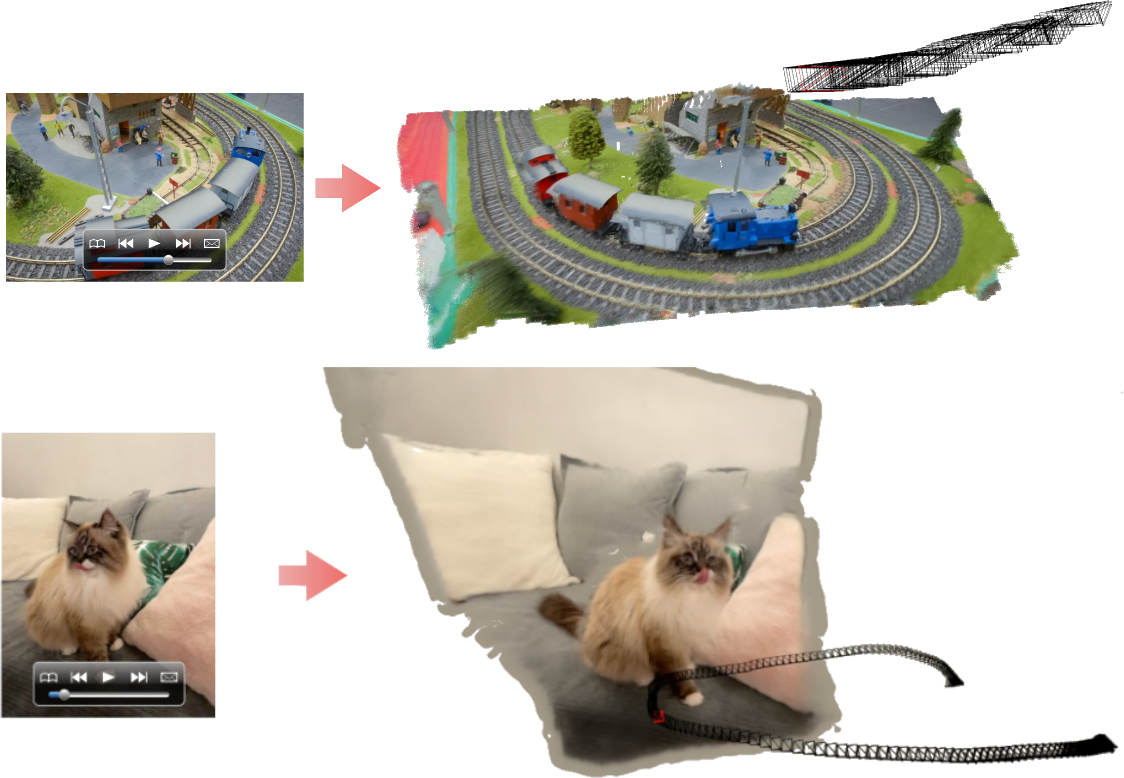
D-NPC enables fast, non-rigid view synthesis from monocular video by expanding extending Implicit Neural Point Clouds (INPC) to the temporal domain.
© Website by Timon Scholz, 2026 · commit 8b9bc89